HP Printer Error Codes Explained: E0–E9, 49, 79 & More
The difficulty is that HP manufactures many different printer families. An E3 code on a DeskJet inkjet does not necessarily mean the same thing as a numbered service error on a LaserJet. Even printers that look similar may use different displays, warning lights and troubleshooting procedures.
This guide explains common HP printer error codes and messages, including:
- HP DeskJet E0–E9 errors
- Ink cartridge and printhead messages
- Ink System Failure and
0xcodes - Paper jam and carriage errors
- HP LaserJet service codes
- Wi-Fi, offline and connection messages
- Scanner and automatic document feeder errors
- Safe troubleshooting steps
- When a printer may require professional repair
Important: HP error codes are model-specific. Always record the full code and check it against the support page for your exact printer model before replacing parts or changing firmware.
HP Printer Error Codes: Quick Lookup Chart
Use this table as a starting point. More detailed explanations appear below.
| Error code or message | Common meaning | First action |
|---|---|---|
| E0 | Cartridge problem | Check, remove and reinstall the indicated cartridge |
| E1 | Paper-size mismatch | Match the loaded paper to the print setting |
| E2 | Paper-length or paper-size mismatch | Check the document and tray paper settings |
| E3 | Carriage jam or obstruction | Inspect the cartridge carriage path |
| E4 | Paper jam | Clear paper from every accessible paper path |
| E5 | Scanner error | Restart and test the scanner again |
| E6 | General printer error state | Perform a power restart |
| E9 | Firmware or update-related state on selected models | Allow the update to finish or follow model-specific guidance |
| Cartridge Problem | Cartridge cannot be read or used | Check the number, contacts and installation |
| Incompatible Cartridge | Wrong cartridge or regional mismatch | Confirm the cartridge family and printer region |
| Missing or Damaged Cartridge | Cartridge is absent or not communicating | Reinstall or test a replacement |
| Ink System Failure | Ink delivery, printhead or cartridge problem | Inspect cartridges and restart the printer |
| Printhead Problem | Printhead cannot operate or communicate | Reseat it if user-removable; otherwise seek support |
| 0x6100004a | Paper-path, carriage or mechanical problem | Check for jams and carriage obstructions |
| 0xc19a… | Ink-system or printhead fault | Inspect cartridges and printhead, then restart |
| 13.xx | Paper jam on many LaserJets | Find and remove paper from the indicated location |
| 20 | Insufficient printer memory | Simplify the job or add memory where supported |
| 41.3 | Unexpected paper size | Check tray guides and paper settings |
| 49 | Firmware or print-job communication error | Cancel the job and restart the printer |
| 50.x | Fuser fault on many LaserJets | Restart once; arrange service if it returns |
| 51.x | Laser or beam-detection error | Restart and seek service if persistent |
| 52.x | Scanner or laser-scanner assembly error | Restart and check model-specific support |
| 54.x | Sensor or toner-related hardware error | Check supplies and arrange service if needed |
| 55.x | Internal communication error | Restart and disconnect accessories |
| 57.x | Fan error | Switch off and check ventilation |
| 59.x | Motor or drive error | Restart; inspect consumables and paper path |
| 79 | Firmware or invalid print-job error | Disconnect network/USB, restart and isolate the job |
| Printer Offline | Computer cannot communicate with printer | Check connection, queue and selected printer |
| Attention Required | Printer needs user action | Read the display or HP app for the underlying fault |
Before Troubleshooting an HP Error Code
Before changing settings or buying replacement parts, record:
- The complete error code
- Every word in the message
- Which warning lights are flashing
- The printer’s full model number
- What happened immediately before the error
- Whether cartridges, toner or paper were recently changed
- Whether firmware or software was recently updated
- Whether the error appears during start-up or only when printing
- Whether the printer can produce an internal test page
A photograph of the display can be useful if the error disappears after restarting.
HP DeskJet E0–E9 Error Codes
Short codes such as E0, E1 and E4 are common on HP DeskJet and similar home printers with small segment displays.
The exact interpretation can vary, so use the following explanations as a guide rather than assuming they apply universally.
HP Printer E0 Error: Cartridge Problem
An E0 error commonly indicates a problem with one or both ink cartridges.
Possible causes include:
- The cartridge is not installed correctly
- The cartridge number is incompatible
- Protective tape remains attached
- The electrical contacts are dirty
- The cartridge is damaged
- The printer cannot communicate with the cartridge
- The cartridge is intended for another region
- A previously used cartridge has failed
- Firmware cannot recognise the cartridge
How to fix HP error E0
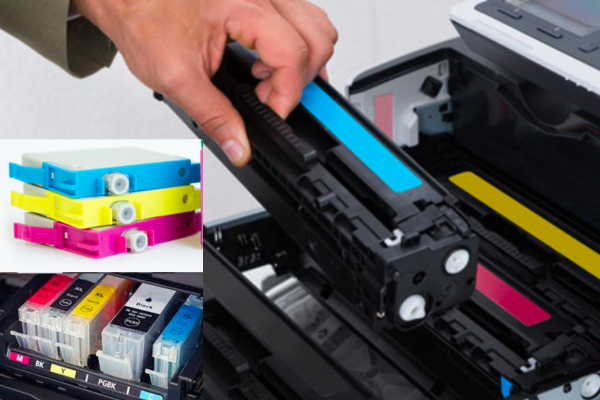
- Open the cartridge-access door.
- Wait until the carriage stops moving.
- Identify the cartridge indicated by the flashing Ink Level icon.
- Remove that cartridge.
- Confirm that its number matches the printer.
- Remove any remaining protective tape.
- Inspect the copper-coloured electrical contacts.
- Reinstall the cartridge firmly.
- Close the access door.
- Wait for the printer to complete its check.
If the error remains, test another suitable cartridge if one is available.
Avoid touching the ink nozzles or copper contacts with your fingers. Oils and dirt can interfere with communication.
For help finding the correct cartridge, use our HP Ink Cartridge Compatibility Chart UK.
HP Printer E1 Error: Paper-Size Mismatch
An E1 error commonly means that the paper width detected by the printer does not match the size selected in the software.
For example, the printer may contain A4 paper while the document or driver is configured for Letter paper.
How to fix HP error E1
- Check the paper loaded in the input tray.
- Move the paper-width guides against the paper without bending it.
- Open the print dialogue on the computer or mobile device.
- Select the correct paper size.
- Confirm the same size in HP Smart or the printer settings.
- Cancel the failed job and print it again.
For UK printing, check carefully whether the document is set to:
- A4
- A5
- 10 × 15 cm
- Letter
- Legal
- Another custom size
A4 and US Letter are not identical.
HP Printer E2 Error: Paper-Length Mismatch
An E2 error usually means the paper length detected during printing does not agree with the print-job setting.
This can be caused by:
- Incorrect paper-size selection
- Paper loaded in the wrong orientation
- Multiple sheets feeding together
- Paper slipping during feeding
- Incorrectly positioned tray guides
- A custom document size
- Dirty or worn feed rollers
HP’s current guidance distinguishes E1 as a paper-size mismatch and E2 as a paper-length mismatch on supported DeskJet models. HP DeskJet error-code guidance
How to fix HP error E2
- Remove the paper.
- Check that the sheets are flat and uniform.
- Reload the correct size.
- Adjust the paper guides.
- Confirm the paper size in the application.
- Confirm the size in the printer driver or HP Smart.
- Print the document again.
HP Printer E3 Error: Carriage Jam
An E3 error commonly indicates that the cartridge carriage is obstructed or cannot move correctly.
The carriage is the moving assembly that holds the ink cartridges.
Possible causes include:
- Jammed paper
- Torn paper inside the printer
- Packaging material left inside
- An incorrectly installed cartridge
- An open cartridge-access door
- A foreign object in the carriage path
- A mechanical carriage fault
How to fix HP error E3
- Cancel the print job.
- Switch off the printer.
- Disconnect the power cable.
- Open the cartridge-access area.
- Use a torch to inspect the carriage path.
- Remove accessible scraps of paper or debris.
- Check that the cartridges are properly installed.
- Close all access doors.
- Reconnect the power.
- Switch on the printer.
Do not force the carriage. If it is mechanically locked, forcing it may damage the belt, encoder strip or carriage assembly.
HP Printer E4 Error: Paper Jam
An E4 error normally means the printer has detected a paper jam.
The visible sheet may not be the only obstruction. Small scraps can remain:
- Under the carriage
- Inside the input tray
- Near the output rollers
- Behind a rear access panel
- Inside the duplex unit
- Inside the automatic document feeder
How to fix HP error E4
- Switch off and unplug the printer.
- Remove loose paper from the input and output trays.
- Open the appropriate access areas.
- Pull jammed paper slowly in the normal direction of travel.
- Remove any torn pieces.
- Check that the carriage path is clear.
- Inspect the feed rollers.
- Close every door securely.
- Reload a small stack of suitable paper.
- Restart the printer.
Do not use sharp tools to remove jammed paper.
If the printer continues reporting a jam when no paper is visible, a small scrap, dirty roller or damaged paper sensor may be responsible.
HP Printer E5 Error: Scanner Problem
An E5 error commonly indicates that the scanner is not functioning correctly.
The printer may still be able to print even if scanning is unavailable.
Possible causes include:
- A temporary scanner control error
- The scanner mechanism cannot initialise
- The scanner carriage is obstructed
- A cable or sensor fault
- Internal hardware failure
How to fix HP error E5
- Cancel the current scan.
- Check whether any packing lock or material remains in place.
- Restart the printer.
- Try scanning from the control panel.
- Test through HP Smart.
- Check the scanner glass and lid.
- Install current software for the exact model.
If the scanner makes repeated grinding noises or cannot initialise after restarting, the printer may require repair.
HP Printer E6 Error: General Error State
An E6 code commonly represents a general printer error that could not be shown as a more specific code.
How to fix HP error E6
- Switch off the printer.
- Disconnect the power cable.
- Wait approximately 60 seconds.
- Reconnect the cable.
- Switch the printer on.
- Wait until it becomes idle.
- Try printing an internal test page.
HP’s user guidance for supported models recommends restarting after an E6 error and contacting support if it persists. HP printer support
If E6 returns immediately during start-up, record the model and all flashing-light patterns before arranging support.
HP Printer E9 Error
On selected HP home printers, E9 can relate to a firmware update or maintenance state. Its meaning is more model-dependent than E1–E6.
If E9 appears:
- Do not unplug the printer while an update is visibly progressing.
- Allow enough time for the process to complete.
- Check HP Smart for further instructions.
- Confirm that the internet connection is stable.
- Restart only if the update has clearly stopped and the model’s instructions permit it.
- Search HP Support using the exact printer model and
E9.
Disconnecting power during an active firmware installation can prevent the printer from starting normally.
HP Ink Cartridge Error Messages
HP cartridge problems may appear as words rather than short codes.
Common messages include:
- Cartridge Problem
- Incompatible Cartridge
- Missing or Damaged Cartridge
- Cartridge Not Intended for This Printer
- Remove and Reinstall Cartridge
- Cartridges Blocked
- Cartridge Failure
- Cartridge Depleted
- Used, Refilled or Counterfeit Cartridge Detected
- Supply System Problem
- Protected Cartridge
- Indicated Cartridges Are Not Communicating Correctly
“Incompatible Cartridge” Message
This means the printer cannot accept or authenticate the installed cartridge.
Possible causes include:
- Incorrect cartridge number
- Cartridge intended for another printer family
- Regional incompatibility
- Damaged electronic circuitry
- Cartridge not seated correctly
- Cartridge protection
- Firmware-related recognition
- Instant Ink cartridge used outside an active subscription
- Setup cartridge used incorrectly
What to check
- Match the number to your exact printer model.
- Check the UK or European cartridge version.
- Remove all packaging and protective tape.
- Reinstall the cartridge.
- Inspect the contacts for damage.
- Restart the printer.
- Test another correct cartridge if available.
Two cartridges with a similar shape are not necessarily compatible. For UK models, consult our HP Ink Cartridge Compatibility Chart UK before ordering replacements.
“Missing or Damaged Cartridge” Message
This message appears when the printer cannot detect an installed cartridge reliably.
The cartridge may be:
- Absent
- Loose
- Installed in the wrong slot
- Electronically damaged
- Physically damaged
- Covered by protective material
- Unable to communicate through dirty contacts
Remove and reinstall only the cartridge indicated by the printer. If the message moves to a different slot after cartridges are changed, follow model-specific instructions; do not install colours in incorrect positions merely as a test.
“Cartridge Problem” Message
A general Cartridge Problem message does not always mean the cartridge is empty.
It can indicate:
- Incorrect installation
- Failed contact
- Incompatible product
- Damaged cartridge
- Regional mismatch
- Printhead communication failure
Record whether the printer identifies a specific colour. That information helps separate a single-cartridge fault from a wider carriage or printhead problem.
“Protected Cartridge” Message
HP Cartridge Protection can associate a cartridge with a particular printer or group of printers.
A protected cartridge may be rejected when moved to another printer, even if the cartridge number would normally be compatible.
If you purchased a used printer or cartridge, confirm whether Cartridge Protection was previously enabled.
Do not confuse Cartridge Protection with:
- Cartridge compatibility
- Regionalisation
- HP+
- Instant Ink
- Dynamic Security
These are related to cartridge use in different ways but are not the same feature.
“Cartridges Blocked” Message
A Cartridges Blocked message can relate to cartridge security, electronic recognition, printer configuration or firmware.
Before replacing the cartridge:
- Confirm its number.
- Check that it is designed for the UK printer model.
- Restart the printer.
- Inspect the contacts.
- Review recent firmware changes.
- Ask the cartridge supplier to confirm the chip version.
Do not install unofficial firmware intended for another model.
HP Instant Ink Cartridge Messages
Instant Ink cartridges are supplied as part of HP’s subscription service. They are linked to the enrolled printer and subscription status.
Messages may appear when:
- The subscription has ended
- Payment or account information needs attention
- The printer has been disconnected from the internet
- A subscription cartridge has been moved to another printer
- The printer cannot contact the service
- Retail and subscription cartridges have been mixed in an unsupported way
If an Instant Ink subscription has ended, install suitable retail cartridges to continue printing.
HP Ink System Failure and 0xc19a Error Codes
Messages such as the following normally indicate a wider ink-delivery or printhead problem:
- Ink System Failure
- System Supply Problem
- Problem with Ink System
- Print System Problem
- Printer Failure
0xc19a00030xc19a0020- Other codes beginning with
0xc19a
The final digits may vary by printer and failure condition. Do not assume that every 0xc19a code identifies exactly the same failed component.
Possible causes include:
- A leaking or damaged cartridge
- An incorrectly installed cartridge
- Air or ink-delivery problems
- Printhead communication failure
- A loose removable printhead
- A damaged printhead
- Internal ink-system failure
- Firmware or control error
HP’s troubleshooting sequence for an Ink System Failure can include checking the cartridges, reseating a user-removable printhead, resetting the printer and arranging service if the fault remains. HP Ink System Failure guidance
How to troubleshoot an HP Ink System Failure
- Record the complete alphanumeric code.
- Check cartridges for leakage or physical damage.
- Confirm that every cartridge is in the correct position.
- Reinstall the cartridges.
- Restart the printer.
- Reseat the printhead only if HP describes it as user-removable.
- Print a quality report if the printer becomes operational.
- Contact HP or a repair technician if the error returns.
Never force out a fixed printhead or release a latch not intended for users.
HP Error 0x6100004a
Error 0x6100004a commonly appears on selected HP OfficeJet printers after a paper jam or when the carriage cannot move correctly.
It may involve:
- Paper remaining inside the printer
- A blocked carriage path
- A cartridge-access door not properly closed
- Incorrectly seated cartridges
- A paper-feed obstruction
- A mechanical carriage fault
HP’s official instructions for this error include ensuring the cartridge-access door is closed, clearing the error and arranging service if it cannot be resolved. HP 0x6100004a support guidance
What to do
- Remove paper from the trays.
- Inspect accessible paper paths.
- Check beneath and around the carriage.
- Remove visible scraps without dismantling the printer.
- Make sure the cartridges are seated correctly.
- Close every access door.
- Restart the printer.
If the carriage is locked or makes grinding sounds, stop and arrange service.
“Printhead Problem” or “Missing or Failed Printhead”
This message means the printer cannot communicate with or correctly operate the printhead.
Potential causes include:
- Printhead not installed correctly
- Electrical contacts are dirty
- Printhead latch is open
- Incorrect replacement printhead
- Printhead failure
- Carriage electronics failure
- Ink-system fault
What to do
- Restart the printer.
- Check the cartridges.
- Reseat the printhead only if the manual describes it as removable.
- Ensure any printhead latch is fully closed.
- Install current HP software or firmware if the printer remains accessible.
- Arrange repair if the message returns.
Repeated cleaning cycles will not repair an electronically failed printhead and may consume a significant amount of ink.
HP Paper and Tray Messages
“Paper Mismatch” or “Paper Size Mismatch”
This means the selected document size does not match the paper detected in the tray.
Check:
- Document page size
- Printer-driver paper size
- Tray paper size
- Paper orientation
- Tray guides
- A4 versus Letter selection
In the UK, an accidental Letter setting is a common cause when A4 paper is loaded.
“Out of Paper” When Paper Is Loaded
Possible causes include:
- Too few or too many sheets
- Paper guides are too loose or tight
- Curled, damp or glossy paper
- Dirty feed rollers
- Incorrect paper type
- Paper not pushed far enough into the tray
- Worn pickup roller
- Failed paper sensor
Remove the stack, square the edges and reload a modest quantity of supported paper.
“Load Tray 1” or “Load Tray 2”
This message may mean:
- The requested tray is empty
- The print job requires a different size
- The tray is configured for another paper type
- Manual feed was selected
- The application is requesting Letter rather than A4
Check the full message. It may specify a size or type such as:
- A4
- Plain
- Letter
- Labels
- Envelope
- Heavy paper
HP LaserJet Error Codes
Numbered LaserJet service errors often refer to paper-path, firmware, memory, fuser, scanner, motor or internal communication problems.
Their precise interpretation varies by model.
HP LaserJet 13.xx Error: Paper Jam
A 13.xx code generally indicates a paper jam.
The digits after 13 can identify the approximate location or paper-path stage, such as:
- Input tray
- Registration area
- Duplexer
- Fuser
- Output area
- Automatic document feeder
What to do
- Read the complete code and display message.
- Remove the toner cartridge if instructed.
- Check the indicated access door.
- Remove paper slowly.
- Look for torn scraps.
- Check tray guides and paper quality.
- Reinstall the toner cartridge.
- Print a test page.
Laser printer fusers become extremely hot. Allow the printer to cool before touching areas carrying a heat warning.
HP LaserJet Error 20: Insufficient Memory
An error 20 commonly means the printer does not have enough available memory to process the job.
Try:
- Cancelling the job
- Printing fewer pages at once
- Reducing image resolution
- Flattening complex PDF files
- Removing unnecessary fonts or graphics
- Selecting a standard rather than high-resolution mode
- Adding printer memory if the model supports it
A damaged or unusually complex document can trigger the error even when normal files print successfully.
HP LaserJet Error 21: Page Too Complex
A 21 error can indicate that the page is too complex for the printer to process at the selected resolution or speed.
Simplify the document, reduce the resolution or print the content in smaller sections.
HP LaserJet Error 22: Input/Output Configuration
Older LaserJet models may use error 22 for an I/O or connection problem.
Check:
- USB or network cable
- Print server
- Network connection
- Computer print queue
- Driver
- External accessories
The meaning is model-dependent, so consult the exact printer manual.
HP LaserJet Error 41.3: Unexpected Paper Size
Error 41.3 usually indicates that the printer detected a different paper size from the one expected.
Check:
- Tray size setting
- Paper guides
- Document size
- Driver setting
- Multipurpose tray configuration
- Paper-feed behaviour
A slipping sheet or multiple-sheet feed can cause the printer to measure an unexpected page length.
HP LaserJet Error 49: Firmware or Print-Job Error
An HP 49 error generally indicates a firmware communication problem. HP’s first recommended action is to power-cycle the printer and then check firmware if necessary. HP 49 error guidance
Common triggers include:
- Corrupted print job
- Problematic PDF or document
- Driver incompatibility
- Firmware issue
- Network communication
- Third-party accessory
- Stored job
- Formatter fault
How to isolate error 49
- Cancel the print queue.
- Disconnect the network or USB cable.
- Restart the printer.
- Check whether it reaches Ready while disconnected.
- Delete the original failed job.
- Reconnect the printer.
- Print a simple internal page.
- Try the document from another application.
- Check the correct firmware and driver.
If the error appears only when one document is printed, the job is more likely to be responsible than the printer hardware.
HP LaserJet Error 50.x: Fuser Error
A 50.x error commonly relates to the fuser, which uses heat and pressure to bond toner to paper.
Possible causes include:
- Fuser not reaching the required temperature
- Excessive fuser temperature
- Incorrect power supply
- Fuser connection problem
- Failed heating element
- Internal power component
- Incorrect replacement fuser
What to do
- Switch the printer off.
- Allow it to cool.
- Check that the power cable is secure.
- Connect it to a suitable outlet.
- Restart once.
- Arrange service if the error returns.
Do not touch the fuser immediately after printing.
HP LaserJet Error 51.x or 52.x
Codes beginning with 51 or 52 can relate to the laser/scanner assembly or beam-detection system on supported LaserJets.
Try a normal restart. If the code returns before any print job is sent, professional service may be required.
Do not confuse a LaserJet laser-scanner assembly error with a document scanner error on a multifunction inkjet.
HP LaserJet Error 54.x
A 54.x code can indicate a sensor, toner-supply, density or internal hardware problem, depending on the model.
Check:
- Toner cartridge installation
- Sealing strip removal
- Transfer components
- Printer doors
- Recent maintenance
- Model-specific HP instructions
Avoid purchasing parts until the complete code has been verified.
HP LaserJet Error 55.x
A 55.x error often indicates an internal communication or controller problem.
Possible actions include:
- Restarting the printer
- Disconnecting USB devices and optional accessories
- Removing queued jobs
- Checking firmware
- Reseating authorised accessories
- Arranging service
HP LaserJet Error 57.x: Fan Error
A 57.x code can indicate that an internal cooling fan is blocked or has failed.
Switch off the printer and check:
- Ventilation openings
- Dust buildup outside the machine
- Nearby objects blocking airflow
- Unusual fan noises
Do not open electrical covers or insert tools through the ventilation slots.
HP LaserJet Error 59.x: Motor Error
A 59.x error commonly relates to an internal motor or drive mechanism.
Possible causes include:
- Incorrectly installed toner
- Jammed transfer component
- Obstructed paper path
- Motor failure
- Gear or drive problem
- Packaging material left inside a new printer
Remove and reinstall user-replaceable supplies, inspect accessible paper paths and restart. Arrange service if the error returns.
HP LaserJet Error 79
Error 79 generally relates to firmware, a corrupted print job or communication with the printer.
How to troubleshoot error 79
- Switch off the printer.
- Disconnect the network and USB connections.
- Cancel all queued print jobs from connected computers.
- Restart the printer while disconnected.
- Print an internal configuration page.
- Reconnect one interface.
- Send a simple test document.
- Identify whether one file, driver or computer triggers the error.
- Check firmware for the exact model.
If the printer displays error 79 while completely disconnected, the fault may require deeper firmware recovery or service.
HP Network and Connection Messages
“Printer Offline”
Printer Offline does not normally mean that the printer itself is switched off. It means the computer cannot communicate with it through the selected connection.
Check:
- Printer power
- Wi-Fi or Ethernet connection
- USB cable
- Computer and printer network
- Default printer selection
- Duplicate printer installations
- Print queue status
- Changed IP address
- Driver
- VPN or firewall
- Router availability
If the printer can produce an internal test page, the printer engine is working and the problem is likely in the connection, queue or software.
“Attention Required”
Attention Required is a general Windows or printer-status message rather than a precise diagnosis.
Possible underlying causes include:
- Paper jam
- Empty tray
- Open cover
- Cartridge error
- User confirmation required
- Incorrect paper type
- Paused queue
- Authentication request
- Failed print job
Open the queue, HP Smart or the printer’s control panel to find the underlying message.
This message indicates that Windows cannot use the installed printer driver correctly.
Try:
- Restarting the printer and computer
- Removing duplicate installations
- Running Windows Update
- Installing the official software for the exact model
- Removing and adding the printer again
- Checking whether the printer supports the current operating system
Download drivers only from HP or the operating-system provider.
“Unable to Communicate with Printer”
Possible causes include:
- Different Wi-Fi networks
- Weak signal
- Changed router password
- Changed printer IP address
- VPN interference
- Firewall restriction
- Printer in deep sleep
- USB or Ethernet cable fault
- Router isolation settings
Print a network report and compare the printer’s network name and IP address with the connected computer.
Scanner and ADF Messages
“Scanner Failure” or “Scanner System Failure”
A scanner error may involve:
- Scanner carriage cannot initialise
- Obstruction under the scanner glass
- Internal cable or sensor failure
- Temporary firmware issue
- Software communication problem
Restart the printer and test a copy directly from the control panel. If copying also fails, the problem is more likely within the printer than the computer software.
“Document Feeder Jam”
Check:
- ADF input tray
- ADF cover
- Pickup rollers
- Output slot
- Torn scraps of paper
- Staples or paper clips
- Folded or damaged originals
Use only clean, flat originals within the feeder’s supported size and thickness.
Safe HP Printer Power Restart
A proper power restart can clear temporary control, communication and sensor errors.
- Wait until the printer stops attempting to move.
- Switch it off normally if possible.
- Disconnect the power cable.
- Wait approximately 60 seconds.
- Reconnect the cable.
- Switch on the printer.
- Wait until it becomes idle.
- Test an internal report before printing from the computer.
A restart will not repair damaged hardware, make an incompatible cartridge compatible or remove a physical obstruction.
Should You Perform a Factory Reset?
A factory reset is different from a power restart. It may erase:
- Wi-Fi details
- Preferences
- Address-book entries
- Web-service settings
- Custom tray settings
- Stored credentials
- Fax settings
Use a factory reset only when the model-specific instructions recommend it and you are prepared to configure the printer again.
When to Stop Troubleshooting
Disconnect the printer and arrange qualified support if:
- You smell burning or see smoke
- Liquid has entered the printer
- The power cable is damaged
- The printer repeatedly trips the electrical supply
- The carriage makes severe grinding noises
- A fuser or internal component appears damaged
- The printer cannot complete start-up
- A hardware error returns while disconnected from all computers
- The printhead or carriage is physically damaged
- The printer was dropped
- The recommended user-level steps do not clear the fault
Do not open electrical, high-voltage or laser assemblies.
Frequently Asked Questions
How do I find the meaning of an HP printer error code?
Record the full code and search HP Support using the exact printer model. Short codes can have different meanings across HP DeskJet, ENVY, OfficeJet and LaserJet printers.
What does E0 mean on an HP printer?
On many HP DeskJet printers, E0 indicates a cartridge problem. Confirm the cartridge number, remove protective material and reinstall the indicated cartridge.
What does E1 mean on an HP printer?
E1 usually indicates that the paper width or selected paper size does not match the print job.
What does E2 mean on an HP printer?
E2 commonly indicates a paper-length mismatch. Check the loaded paper, tray guides and document size.
What does E3 mean on an HP printer?
E3 usually points to a carriage jam or obstruction on supported HP DeskJet printers. Inspect the accessible carriage path for jammed paper or debris.
What does E4 mean on an HP printer?
E4 usually means the printer has detected a paper jam. Check the input tray, cartridge-access area, rear paper path, duplexer and output area.
What does E5 mean on an HP printer?
E5 commonly indicates a scanner failure. Restart the printer and test scanning or copying again.
What does E6 mean on an HP printer?
E6 generally means the printer is in an unspecified error state. Perform a power restart and check HP Support if the code returns.
Why does my HP printer show an error when there is no paper jam?
A small piece of paper, dirty roller, obstructed carriage or damaged paper sensor can produce a jam message even when no full sheet is visible.
What does Ink System Failure mean?
It indicates that the printer has detected a problem involving its cartridges, ink delivery or printhead. Check for damaged cartridges, reinstall them and follow the model-specific printhead guidance.
What does HP error 0x6100004a mean?
On supported OfficeJet models, it commonly relates to the paper path, carriage movement or a mechanical obstruction, sometimes following a paper jam.
What does error 49 mean on an HP LaserJet?
Error 49 generally indicates a firmware communication problem or invalid print job. Clear the queue, disconnect the printer, restart it and identify whether a particular file triggers the error.
What does error 50 mean on an HP LaserJet?
A 50-series error normally relates to the fuser or its power and temperature control. Restart once and arrange service if it returns.
What does error 79 mean on an HP printer?
Error 79 is commonly associated with firmware or a problematic print job. Disconnect network and USB cables, restart the printer and clear the print queue.
Can incompatible cartridges cause an HP error code?
Yes. Incorrect cartridge numbers, regional incompatibility, damaged electronic contacts or unsupported cartridges can produce E0, Incompatible Cartridge, Cartridge Problem and similar messages.
Will resetting an HP printer remove an error code?
A power restart may clear a temporary error. It will not fix a paper obstruction, damaged cartridge, failed printhead, bad fuser or other physical problem.
Can firmware cause HP cartridge errors?
Firmware can change cartridge-recognition behaviour on some printers. However, incorrect cartridges, damaged chips, dirty contacts and regional mismatches can produce similar messages.
Should I update the firmware when an error appears?
Only update firmware intended for the exact printer model, and do not interrupt the installation. First establish whether the code concerns firmware, hardware, paper or cartridges.
How do I clear an HP printer error state in Windows?
Resolve the physical printer message first. Then clear failed jobs, restart the Print Spooler, confirm the correct printer is selected and test the connection.
When does an HP printer need professional repair?
Professional help may be necessary when a hardware or service error returns during start-up, the carriage is mechanically locked, the printer has electrical symptoms, or a fuser, motor, scanner assembly or printhead has failed.
Final HP Error-Code Checklist
Before arranging a repair, confirm that you have:
- Recorded the full code and message
- Identified the exact printer model
- Checked the display and warning lights
- Removed visible paper jams
- Inspected the carriage path
- Checked paper-size settings
- Confirmed cartridge compatibility
- Reinstalled cartridges correctly
- Tested an internal report
- Cleared the print queue
- Checked USB, Ethernet or Wi-Fi
- Performed a safe power restart
- Checked the official support page
- Reviewed warranty or repair options
The error code should be treated as the beginning of the diagnosis, not a universal answer. Use it together with the complete model, warning lights and symptoms to identify the correct solution.
An HP printer error code can point to something simple, such as the wrong paper size, or a more serious problem involving the carriage, printhead, firmware or internal hardware.
The difficulty is that HP manufactures many different printer families. An E3 code on a DeskJet inkjet does not necessarily mean the same thing as a numbered service error on a LaserJet. Even printers that look similar may use different displays, warning lights and troubleshooting procedures.
This guide explains common HP printer error codes and messages, including:
- HP DeskJet E0–E9 errors
- Ink cartridge and printhead messages
- Ink System Failure and
0xcodes - Paper jam and carriage errors
- HP LaserJet service codes
- Wi-Fi, offline and connection messages
- Scanner and automatic document feeder errors
- Safe troubleshooting steps
- When a printer may require professional repair
Important: HP error codes are model-specific. Always record the full code and check it against the support page for your exact printer model before replacing parts or changing firmware.
HP Printer Error Codes: Quick Lookup Chart
Use this table as a starting point. More detailed explanations appear below.
| Error code or message | Common meaning | First action |
|---|---|---|
| E0 | Cartridge problem | Check, remove and reinstall the indicated cartridge |
| E1 | Paper-size mismatch | Match the loaded paper to the print setting |
| E2 | Paper-length or paper-size mismatch | Check the document and tray paper settings |
| E3 | Carriage jam or obstruction | Inspect the cartridge carriage path |
| E4 | Paper jam | Clear paper from every accessible paper path |
| E5 | Scanner error | Restart and test the scanner again |
| E6 | General printer error state | Perform a power restart |
| E9 | Firmware or update-related state on selected models | Allow the update to finish or follow model-specific guidance |
| Cartridge Problem | Cartridge cannot be read or used | Check the number, contacts and installation |
| Incompatible Cartridge | Wrong cartridge or regional mismatch | Confirm the cartridge family and printer region |
| Missing or Damaged Cartridge | Cartridge is absent or not communicating | Reinstall or test a replacement |
| Ink System Failure | Ink delivery, printhead or cartridge problem | Inspect cartridges and restart the printer |
| Printhead Problem | Printhead cannot operate or communicate | Reseat it if user-removable; otherwise seek support |
| 0x6100004a | Paper-path, carriage or mechanical problem | Check for jams and carriage obstructions |
| 0xc19a… | Ink-system or printhead fault | Inspect cartridges and printhead, then restart |
| 13.xx | Paper jam on many LaserJets | Find and remove paper from the indicated location |
| 20 | Insufficient printer memory | Simplify the job or add memory where supported |
| 41.3 | Unexpected paper size | Check tray guides and paper settings |
| 49 | Firmware or print-job communication error | Cancel the job and restart the printer |
| 50.x | Fuser fault on many LaserJets | Restart once; arrange service if it returns |
| 51.x | Laser or beam-detection error | Restart and seek service if persistent |
| 52.x | Scanner or laser-scanner assembly error | Restart and check model-specific support |
| 54.x | Sensor or toner-related hardware error | Check supplies and arrange service if needed |
| 55.x | Internal communication error | Restart and disconnect accessories |
| 57.x | Fan error | Switch off and check ventilation |
| 59.x | Motor or drive error | Restart; inspect consumables and paper path |
| 79 | Firmware or invalid print-job error | Disconnect network/USB, restart and isolate the job |
| Printer Offline | Computer cannot communicate with printer | Check connection, queue and selected printer |
| Attention Required | Printer needs user action | Read the display or HP app for the underlying fault |
Before Troubleshooting an HP Error Code
Before changing settings or buying replacement parts, record:
- The complete error code
- Every word in the message
- Which warning lights are flashing
- The printer’s full model number
- What happened immediately before the error
- Whether cartridges, toner or paper were recently changed
- Whether firmware or software was recently updated
- Whether the error appears during start-up or only when printing
- Whether the printer can produce an internal test page
A photograph of the display can be useful if the error disappears after restarting.
HP DeskJet E0–E9 Error Codes
Short codes such as E0, E1 and E4 are common on HP DeskJet and similar home printers with small segment displays.
The exact interpretation can vary, so use the following explanations as a guide rather than assuming they apply universally.
HP Printer E0 Error: Cartridge Problem
An E0 error commonly indicates a problem with one or both ink cartridges.
Possible causes include:
- The cartridge is not installed correctly
- The cartridge number is incompatible
- Protective tape remains attached
- The electrical contacts are dirty
- The cartridge is damaged
- The printer cannot communicate with the cartridge
- The cartridge is intended for another region
- A previously used cartridge has failed
- Firmware cannot recognise the cartridge
How to fix HP error E0
- Open the cartridge-access door.
- Wait until the carriage stops moving.
- Identify the cartridge indicated by the flashing Ink Level icon.
- Remove that cartridge.
- Confirm that its number matches the printer.
- Remove any remaining protective tape.
- Inspect the copper-coloured electrical contacts.
- Reinstall the cartridge firmly.
- Close the access door.
- Wait for the printer to complete its check.
If the error remains, test another suitable cartridge if one is available.
Avoid touching the ink nozzles or copper contacts with your fingers. Oils and dirt can interfere with communication.
For help finding the correct cartridge, use our HP Ink Cartridge Compatibility Chart UK.
HP Printer E1 Error: Paper-Size Mismatch
An E1 error commonly means that the paper width detected by the printer does not match the size selected in the software.
For example, the printer may contain A4 paper while the document or driver is configured for Letter paper.
How to fix HP error E1
- Check the paper loaded in the input tray.
- Move the paper-width guides against the paper without bending it.
- Open the print dialogue on the computer or mobile device.
- Select the correct paper size.
- Confirm the same size in HP Smart or the printer settings.
- Cancel the failed job and print it again.
For UK printing, check carefully whether the document is set to:
- A4
- A5
- 10 × 15 cm
- Letter
- Legal
- Another custom size
A4 and US Letter are not identical.
HP Printer E2 Error: Paper-Length Mismatch
An E2 error usually means the paper length detected during printing does not agree with the print-job setting.
This can be caused by:
- Incorrect paper-size selection
- Paper loaded in the wrong orientation
- Multiple sheets feeding together
- Paper slipping during feeding
- Incorrectly positioned tray guides
- A custom document size
- Dirty or worn feed rollers
HP’s current guidance distinguishes E1 as a paper-size mismatch and E2 as a paper-length mismatch on supported DeskJet models. HP DeskJet error-code guidance
How to fix HP error E2
- Remove the paper.
- Check that the sheets are flat and uniform.
- Reload the correct size.
- Adjust the paper guides.
- Confirm the paper size in the application.
- Confirm the size in the printer driver or HP Smart.
- Print the document again.
HP Printer E3 Error: Carriage Jam
An E3 error commonly indicates that the cartridge carriage is obstructed or cannot move correctly.
The carriage is the moving assembly that holds the ink cartridges.
Possible causes include:
- Jammed paper
- Torn paper inside the printer
- Packaging material left inside
- An incorrectly installed cartridge
- An open cartridge-access door
- A foreign object in the carriage path
- A mechanical carriage fault
How to fix HP error E3
- Cancel the print job.
- Switch off the printer.
- Disconnect the power cable.
- Open the cartridge-access area.
- Use a torch to inspect the carriage path.
- Remove accessible scraps of paper or debris.
- Check that the cartridges are properly installed.
- Close all access doors.
- Reconnect the power.
- Switch on the printer.
Do not force the carriage. If it is mechanically locked, forcing it may damage the belt, encoder strip or carriage assembly.
HP Printer E4 Error: Paper Jam
An E4 error normally means the printer has detected a paper jam.
The visible sheet may not be the only obstruction. Small scraps can remain:
- Under the carriage
- Inside the input tray
- Near the output rollers
- Behind a rear access panel
- Inside the duplex unit
- Inside the automatic document feeder
How to fix HP error E4
- Switch off and unplug the printer.
- Remove loose paper from the input and output trays.
- Open the appropriate access areas.
- Pull jammed paper slowly in the normal direction of travel.
- Remove any torn pieces.
- Check that the carriage path is clear.
- Inspect the feed rollers.
- Close every door securely.
- Reload a small stack of suitable paper.
- Restart the printer.
Do not use sharp tools to remove jammed paper.
If the printer continues reporting a jam when no paper is visible, a small scrap, dirty roller or damaged paper sensor may be responsible.
HP Printer E5 Error: Scanner Problem
An E5 error commonly indicates that the scanner is not functioning correctly.
The printer may still be able to print even if scanning is unavailable.
Possible causes include:
- A temporary scanner control error
- The scanner mechanism cannot initialise
- The scanner carriage is obstructed
- A cable or sensor fault
- Internal hardware failure
How to fix HP error E5
- Cancel the current scan.
- Check whether any packing lock or material remains in place.
- Restart the printer.
- Try scanning from the control panel.
- Test through HP Smart.
- Check the scanner glass and lid.
- Install current software for the exact model.
If the scanner makes repeated grinding noises or cannot initialise after restarting, the printer may require repair.
HP Printer E6 Error: General Error State
An E6 code commonly represents a general printer error that could not be shown as a more specific code.
How to fix HP error E6
- Switch off the printer.
- Disconnect the power cable.
- Wait approximately 60 seconds.
- Reconnect the cable.
- Switch the printer on.
- Wait until it becomes idle.
- Try printing an internal test page.
HP’s user guidance for supported models recommends restarting after an E6 error and contacting support if it persists. HP printer support
If E6 returns immediately during start-up, record the model and all flashing-light patterns before arranging support.
HP Printer E9 Error
On selected HP home printers, E9 can relate to a firmware update or maintenance state. Its meaning is more model-dependent than E1–E6.
If E9 appears:
- Do not unplug the printer while an update is visibly progressing.
- Allow enough time for the process to complete.
- Check HP Smart for further instructions.
- Confirm that the internet connection is stable.
- Restart only if the update has clearly stopped and the model’s instructions permit it.
- Search HP Support using the exact printer model and
E9.
Disconnecting power during an active firmware installation can prevent the printer from starting normally.
HP Ink Cartridge Error Messages
HP cartridge problems may appear as words rather than short codes.
Common messages include:
- Cartridge Problem
- Incompatible Cartridge
- Missing or Damaged Cartridge
- Cartridge Not Intended for This Printer
- Remove and Reinstall Cartridge
- Cartridges Blocked
- Cartridge Failure
- Cartridge Depleted
- Used, Refilled or Counterfeit Cartridge Detected
- Supply System Problem
- Protected Cartridge
- Indicated Cartridges Are Not Communicating Correctly
“Incompatible Cartridge” Message
This means the printer cannot accept or authenticate the installed cartridge.
Possible causes include:
- Incorrect cartridge number
- Cartridge intended for another printer family
- Regional incompatibility
- Damaged electronic circuitry
- Cartridge not seated correctly
- Cartridge protection
- Firmware-related recognition
- Instant Ink cartridge used outside an active subscription
- Setup cartridge used incorrectly
What to check
- Match the number to your exact printer model.
- Check the UK or European cartridge version.
- Remove all packaging and protective tape.
- Reinstall the cartridge.
- Inspect the contacts for damage.
- Restart the printer.
- Test another correct cartridge if available.
Two cartridges with a similar shape are not necessarily compatible. For UK models, consult our HP Ink Cartridge Compatibility Chart UK before ordering replacements.
“Missing or Damaged Cartridge” Message
This message appears when the printer cannot detect an installed cartridge reliably.
The cartridge may be:
- Absent
- Loose
- Installed in the wrong slot
- Electronically damaged
- Physically damaged
- Covered by protective material
- Unable to communicate through dirty contacts
Remove and reinstall only the cartridge indicated by the printer. If the message moves to a different slot after cartridges are changed, follow model-specific instructions; do not install colours in incorrect positions merely as a test.
“Cartridge Problem” Message
A general Cartridge Problem message does not always mean the cartridge is empty.
It can indicate:
- Incorrect installation
- Failed contact
- Incompatible product
- Damaged cartridge
- Regional mismatch
- Printhead communication failure
Record whether the printer identifies a specific colour. That information helps separate a single-cartridge fault from a wider carriage or printhead problem.
“Protected Cartridge” Message
HP Cartridge Protection can associate a cartridge with a particular printer or group of printers.
A protected cartridge may be rejected when moved to another printer, even if the cartridge number would normally be compatible.
If you purchased a used printer or cartridge, confirm whether Cartridge Protection was previously enabled.
Do not confuse Cartridge Protection with:
- Cartridge compatibility
- Regionalisation
- HP+
- Instant Ink
- Dynamic Security
These are related to cartridge use in different ways but are not the same feature.
“Cartridges Blocked” Message
A Cartridges Blocked message can relate to cartridge security, electronic recognition, printer configuration or firmware.
Before replacing the cartridge:
- Confirm its number.
- Check that it is designed for the UK printer model.
- Restart the printer.
- Inspect the contacts.
- Review recent firmware changes.
- Ask the cartridge supplier to confirm the chip version.
Do not install unofficial firmware intended for another model.
HP Instant Ink Cartridge Messages
Instant Ink cartridges are supplied as part of HP’s subscription service. They are linked to the enrolled printer and subscription status.
Messages may appear when:
- The subscription has ended
- Payment or account information needs attention
- The printer has been disconnected from the internet
- A subscription cartridge has been moved to another printer
- The printer cannot contact the service
- Retail and subscription cartridges have been mixed in an unsupported way
If an Instant Ink subscription has ended, install suitable retail cartridges to continue printing.
HP Ink System Failure and 0xc19a Error Codes
Messages such as the following normally indicate a wider ink-delivery or printhead problem:
- Ink System Failure
- System Supply Problem
- Problem with Ink System
- Print System Problem
- Printer Failure
0xc19a00030xc19a0020- Other codes beginning with
0xc19a
The final digits may vary by printer and failure condition. Do not assume that every 0xc19a code identifies exactly the same failed component.
Possible causes include:
- A leaking or damaged cartridge
- An incorrectly installed cartridge
- Air or ink-delivery problems
- Printhead communication failure
- A loose removable printhead
- A damaged printhead
- Internal ink-system failure
- Firmware or control error
HP’s troubleshooting sequence for an Ink System Failure can include checking the cartridges, reseating a user-removable printhead, resetting the printer and arranging service if the fault remains. HP Ink System Failure guidance
How to troubleshoot an HP Ink System Failure
- Record the complete alphanumeric code.
- Check cartridges for leakage or physical damage.
- Confirm that every cartridge is in the correct position.
- Reinstall the cartridges.
- Restart the printer.
- Reseat the printhead only if HP describes it as user-removable.
- Print a quality report if the printer becomes operational.
- Contact HP or a repair technician if the error returns.
Never force out a fixed printhead or release a latch not intended for users.
HP Error 0x6100004a
Error 0x6100004a commonly appears on selected HP OfficeJet printers after a paper jam or when the carriage cannot move correctly.
It may involve:
- Paper remaining inside the printer
- A blocked carriage path
- A cartridge-access door not properly closed
- Incorrectly seated cartridges
- A paper-feed obstruction
- A mechanical carriage fault
HP’s official instructions for this error include ensuring the cartridge-access door is closed, clearing the error and arranging service if it cannot be resolved. HP 0x6100004a support guidance
What to do
- Remove paper from the trays.
- Inspect accessible paper paths.
- Check beneath and around the carriage.
- Remove visible scraps without dismantling the printer.
- Make sure the cartridges are seated correctly.
- Close every access door.
- Restart the printer.
If the carriage is locked or makes grinding sounds, stop and arrange service.
“Printhead Problem” or “Missing or Failed Printhead”
This message means the printer cannot communicate with or correctly operate the printhead.
Potential causes include:
- Printhead not installed correctly
- Electrical contacts are dirty
- Printhead latch is open
- Incorrect replacement printhead
- Printhead failure
- Carriage electronics failure
- Ink-system fault
What to do
- Restart the printer.
- Check the cartridges.
- Reseat the printhead only if the manual describes it as removable.
- Ensure any printhead latch is fully closed.
- Install current HP software or firmware if the printer remains accessible.
- Arrange repair if the message returns.
Repeated cleaning cycles will not repair an electronically failed printhead and may consume a significant amount of ink.
HP Paper and Tray Messages
“Paper Mismatch” or “Paper Size Mismatch”
This means the selected document size does not match the paper detected in the tray.
Check:
- Document page size
- Printer-driver paper size
- Tray paper size
- Paper orientation
- Tray guides
- A4 versus Letter selection
In the UK, an accidental Letter setting is a common cause when A4 paper is loaded.
“Out of Paper” When Paper Is Loaded
Possible causes include:
- Too few or too many sheets
- Paper guides are too loose or tight
- Curled, damp or glossy paper
- Dirty feed rollers
- Incorrect paper type
- Paper not pushed far enough into the tray
- Worn pickup roller
- Failed paper sensor
Remove the stack, square the edges and reload a modest quantity of supported paper.
“Load Tray 1” or “Load Tray 2”
This message may mean:
- The requested tray is empty
- The print job requires a different size
- The tray is configured for another paper type
- Manual feed was selected
- The application is requesting Letter rather than A4
Check the full message. It may specify a size or type such as:
- A4
- Plain
- Letter
- Labels
- Envelope
- Heavy paper
HP LaserJet Error Codes
Numbered LaserJet service errors often refer to paper-path, firmware, memory, fuser, scanner, motor or internal communication problems.
Their precise interpretation varies by model.
HP LaserJet 13.xx Error: Paper Jam
A 13.xx code generally indicates a paper jam.
The digits after 13 can identify the approximate location or paper-path stage, such as:
- Input tray
- Registration area
- Duplexer
- Fuser
- Output area
- Automatic document feeder
What to do
- Read the complete code and display message.
- Remove the toner cartridge if instructed.
- Check the indicated access door.
- Remove paper slowly.
- Look for torn scraps.
- Check tray guides and paper quality.
- Reinstall the toner cartridge.
- Print a test page.
Laser printer fusers become extremely hot. Allow the printer to cool before touching areas carrying a heat warning.
HP LaserJet Error 20: Insufficient Memory
An error 20 commonly means the printer does not have enough available memory to process the job.
Try:
- Cancelling the job
- Printing fewer pages at once
- Reducing image resolution
- Flattening complex PDF files
- Removing unnecessary fonts or graphics
- Selecting a standard rather than high-resolution mode
- Adding printer memory if the model supports it
A damaged or unusually complex document can trigger the error even when normal files print successfully.
HP LaserJet Error 21: Page Too Complex
A 21 error can indicate that the page is too complex for the printer to process at the selected resolution or speed.
Simplify the document, reduce the resolution or print the content in smaller sections.
HP LaserJet Error 22: Input/Output Configuration
Older LaserJet models may use error 22 for an I/O or connection problem.
Check:
- USB or network cable
- Print server
- Network connection
- Computer print queue
- Driver
- External accessories
The meaning is model-dependent, so consult the exact printer manual.
HP LaserJet Error 41.3: Unexpected Paper Size
Error 41.3 usually indicates that the printer detected a different paper size from the one expected.
Check:
- Tray size setting
- Paper guides
- Document size
- Driver setting
- Multipurpose tray configuration
- Paper-feed behaviour
A slipping sheet or multiple-sheet feed can cause the printer to measure an unexpected page length.
HP LaserJet Error 49: Firmware or Print-Job Error
An HP 49 error generally indicates a firmware communication problem. HP’s first recommended action is to power-cycle the printer and then check firmware if necessary. HP 49 error guidance
Common triggers include:
- Corrupted print job
- Problematic PDF or document
- Driver incompatibility
- Firmware issue
- Network communication
- Third-party accessory
- Stored job
- Formatter fault
How to isolate error 49
- Cancel the print queue.
- Disconnect the network or USB cable.
- Restart the printer.
- Check whether it reaches Ready while disconnected.
- Delete the original failed job.
- Reconnect the printer.
- Print a simple internal page.
- Try the document from another application.
- Check the correct firmware and driver.
If the error appears only when one document is printed, the job is more likely to be responsible than the printer hardware.
HP LaserJet Error 50.x: Fuser Error
A 50.x error commonly relates to the fuser, which uses heat and pressure to bond toner to paper.
Possible causes include:
- Fuser not reaching the required temperature
- Excessive fuser temperature
- Incorrect power supply
- Fuser connection problem
- Failed heating element
- Internal power component
- Incorrect replacement fuser
What to do
- Switch the printer off.
- Allow it to cool.
- Check that the power cable is secure.
- Connect it to a suitable outlet.
- Restart once.
- Arrange service if the error returns.
Do not touch the fuser immediately after printing.
HP LaserJet Error 51.x or 52.x
Codes beginning with 51 or 52 can relate to the laser/scanner assembly or beam-detection system on supported LaserJets.
Try a normal restart. If the code returns before any print job is sent, professional service may be required.
Do not confuse a LaserJet laser-scanner assembly error with a document scanner error on a multifunction inkjet.
HP LaserJet Error 54.x
A 54.x code can indicate a sensor, toner-supply, density or internal hardware problem, depending on the model.
Check:
- Toner cartridge installation
- Sealing strip removal
- Transfer components
- Printer doors
- Recent maintenance
- Model-specific HP instructions
Avoid purchasing parts until the complete code has been verified.
HP LaserJet Error 55.x
A 55.x error often indicates an internal communication or controller problem.
Possible actions include:
- Restarting the printer
- Disconnecting USB devices and optional accessories
- Removing queued jobs
- Checking firmware
- Reseating authorised accessories
- Arranging service
HP LaserJet Error 57.x: Fan Error
A 57.x code can indicate that an internal cooling fan is blocked or has failed.
Switch off the printer and check:
- Ventilation openings
- Dust buildup outside the machine
- Nearby objects blocking airflow
- Unusual fan noises
Do not open electrical covers or insert tools through the ventilation slots.
HP LaserJet Error 59.x: Motor Error
A 59.x error commonly relates to an internal motor or drive mechanism.
Possible causes include:
- Incorrectly installed toner
- Jammed transfer component
- Obstructed paper path
- Motor failure
- Gear or drive problem
- Packaging material left inside a new printer
Remove and reinstall user-replaceable supplies, inspect accessible paper paths and restart. Arrange service if the error returns.
HP LaserJet Error 79
Error 79 generally relates to firmware, a corrupted print job or communication with the printer.
How to troubleshoot error 79
- Switch off the printer.
- Disconnect the network and USB connections.
- Cancel all queued print jobs from connected computers.
- Restart the printer while disconnected.
- Print an internal configuration page.
- Reconnect one interface.
- Send a simple test document.
- Identify whether one file, driver or computer triggers the error.
- Check firmware for the exact model.
If the printer displays error 79 while completely disconnected, the fault may require deeper firmware recovery or service.
HP Network and Connection Messages
“Printer Offline”
Printer Offline does not normally mean that the printer itself is switched off. It means the computer cannot communicate with it through the selected connection.
Check:
- Printer power
- Wi-Fi or Ethernet connection
- USB cable
- Computer and printer network
- Default printer selection
- Duplicate printer installations
- Print queue status
- Changed IP address
- Driver
- VPN or firewall
- Router availability
If the printer can produce an internal test page, the printer engine is working and the problem is likely in the connection, queue or software.
“Attention Required”
Attention Required is a general Windows or printer-status message rather than a precise diagnosis.
Possible underlying causes include:
- Paper jam
- Empty tray
- Open cover
- Cartridge error
- User confirmation required
- Incorrect paper type
- Paused queue
- Authentication request
- Failed print job
Open the queue, HP Smart or the printer’s control panel to find the underlying message.
This message indicates that Windows cannot use the installed printer driver correctly.
Try:
- Restarting the printer and computer
- Removing duplicate installations
- Running Windows Update
- Installing the official software for the exact model
- Removing and adding the printer again
- Checking whether the printer supports the current operating system
Download drivers only from HP or the operating-system provider.
“Unable to Communicate with Printer”
Possible causes include:
- Different Wi-Fi networks
- Weak signal
- Changed router password
- Changed printer IP address
- VPN interference
- Firewall restriction
- Printer in deep sleep
- USB or Ethernet cable fault
- Router isolation settings
Print a network report and compare the printer’s network name and IP address with the connected computer.
Scanner and ADF Messages
“Scanner Failure” or “Scanner System Failure”
A scanner error may involve:
- Scanner carriage cannot initialise
- Obstruction under the scanner glass
- Internal cable or sensor failure
- Temporary firmware issue
- Software communication problem
Restart the printer and test a copy directly from the control panel. If copying also fails, the problem is more likely within the printer than the computer software.
“Document Feeder Jam”
Check:
- ADF input tray
- ADF cover
- Pickup rollers
- Output slot
- Torn scraps of paper
- Staples or paper clips
- Folded or damaged originals
Use only clean, flat originals within the feeder’s supported size and thickness.
Safe HP Printer Power Restart
A proper power restart can clear temporary control, communication and sensor errors.
- Wait until the printer stops attempting to move.
- Switch it off normally if possible.
- Disconnect the power cable.
- Wait approximately 60 seconds.
- Reconnect the cable.
- Switch on the printer.
- Wait until it becomes idle.
- Test an internal report before printing from the computer.
A restart will not repair damaged hardware, make an incompatible cartridge compatible or remove a physical obstruction.
Should You Perform a Factory Reset?
A factory reset is different from a power restart. It may erase:
- Wi-Fi details
- Preferences
- Address-book entries
- Web-service settings
- Custom tray settings
- Stored credentials
- Fax settings
Use a factory reset only when the model-specific instructions recommend it and you are prepared to configure the printer again.
When to Stop Troubleshooting
Disconnect the printer and arrange qualified support if:
- You smell burning or see smoke
- Liquid has entered the printer
- The power cable is damaged
- The printer repeatedly trips the electrical supply
- The carriage makes severe grinding noises
- A fuser or internal component appears damaged
- The printer cannot complete start-up
- A hardware error returns while disconnected from all computers
- The printhead or carriage is physically damaged
- The printer was dropped
- The recommended user-level steps do not clear the fault
Do not open electrical, high-voltage or laser assemblies.
Frequently Asked Questions
How do I find the meaning of an HP printer error code?
Record the full code and search HP Support using the exact printer model. Short codes can have different meanings across HP DeskJet, ENVY, OfficeJet and LaserJet printers.
What does E0 mean on an HP printer?
On many HP DeskJet printers, E0 indicates a cartridge problem. Confirm the cartridge number, remove protective material and reinstall the indicated cartridge.
What does E1 mean on an HP printer?
E1 usually indicates that the paper width or selected paper size does not match the print job.
What does E2 mean on an HP printer?
E2 commonly indicates a paper-length mismatch. Check the loaded paper, tray guides and document size.
What does E3 mean on an HP printer?
E3 usually points to a carriage jam or obstruction on supported HP DeskJet printers. Inspect the accessible carriage path for jammed paper or debris.
What does E4 mean on an HP printer?
E4 usually means the printer has detected a paper jam. Check the input tray, cartridge-access area, rear paper path, duplexer and output area.
What does E5 mean on an HP printer?
E5 commonly indicates a scanner failure. Restart the printer and test scanning or copying again.
What does E6 mean on an HP printer?
E6 generally means the printer is in an unspecified error state. Perform a power restart and check HP Support if the code returns.
Why does my HP printer show an error when there is no paper jam?
A small piece of paper, dirty roller, obstructed carriage or damaged paper sensor can produce a jam message even when no full sheet is visible.
What does Ink System Failure mean?
It indicates that the printer has detected a problem involving its cartridges, ink delivery or printhead. Check for damaged cartridges, reinstall them and follow the model-specific printhead guidance.
What does HP error 0x6100004a mean?
On supported OfficeJet models, it commonly relates to the paper path, carriage movement or a mechanical obstruction, sometimes following a paper jam.
What does error 49 mean on an HP LaserJet?
Error 49 generally indicates a firmware communication problem or invalid print job. Clear the queue, disconnect the printer, restart it and identify whether a particular file triggers the error.
What does error 50 mean on an HP LaserJet?
A 50-series error normally relates to the fuser or its power and temperature control. Restart once and arrange service if it returns.
What does error 79 mean on an HP printer?
Error 79 is commonly associated with firmware or a problematic print job. Disconnect network and USB cables, restart the printer and clear the print queue.
Can incompatible cartridges cause an HP error code?
Yes. Incorrect cartridge numbers, regional incompatibility, damaged electronic contacts or unsupported cartridges can produce E0, Incompatible Cartridge, Cartridge Problem and similar messages.
Will resetting an HP printer remove an error code?
A power restart may clear a temporary error. It will not fix a paper obstruction, damaged cartridge, failed printhead, bad fuser or other physical problem.
Can firmware cause HP cartridge errors?
Firmware can change cartridge-recognition behaviour on some printers. However, incorrect cartridges, damaged chips, dirty contacts and regional mismatches can produce similar messages.
Should I update the firmware when an error appears?
Only update firmware intended for the exact printer model, and do not interrupt the installation. First establish whether the code concerns firmware, hardware, paper or cartridges.
How do I clear an HP printer error state in Windows?
Resolve the physical printer message first. Then clear failed jobs, restart the Print Spooler, confirm the correct printer is selected and test the connection.
When does an HP printer need professional repair?
Professional help may be necessary when a hardware or service error returns during start-up, the carriage is mechanically locked, the printer has electrical symptoms, or a fuser, motor, scanner assembly or printhead has failed.
Final HP Error-Code Checklist
Before arranging a repair, confirm that you have:
- Recorded the full code and message
- Identified the exact printer model
- Checked the display and warning lights
- Removed visible paper jams
- Inspected the carriage path
- Checked paper-size settings
- Confirmed cartridge compatibility
- Reinstalled cartridges correctly
- Tested an internal report
- Cleared the print queue
- Checked USB, Ethernet or Wi-Fi
- Performed a safe power restart
- Checked the official support page
- Reviewed warranty or repair options
The error code should be treated as the beginning of the diagnosis, not a universal answer. Use it together with the complete model, warning lights and symptoms to identify the correct solution.